Roy Rosenzweig Center for History and New Media

Publications

Lorem ipsum dolor sit amet, consectetur adipiscing elit. Sed do eiusmod tempor incididunt ut labore et dolore magna aliqua. Ut enim ad minim veniam, quis nostrud exercitation ullamco laboris nisi ut aliquip ex ea commodo consequat.

Lorem ipsum dolor sit amet, consectetur adipiscing elit. Sed do eiusmod tempor incididunt ut labore et dolore magna aliqua. Ut enim ad minim veniam, quis nostrud exercitation ullamco laboris nisi ut aliquip ex ea commodo consequat.

2025

Publications

Civil Blood: Vendetta Violence and the Civic Elites in Early Modern Italy 

Amanda G. Madden Cornell University Press

Civil Blood examines the practice of vendetta among civic elites in sixteenth-century Italy, illustrating the complex and integral role that vendetta violence played in civic life and state formation. Amanda G. Madden shows how key phenomena of the period—state centralization, growing bureaucracies, institutional reforms, and the process of state formation—were interpenetrated by, and not simply opposed to, ongoing factional violence among civic elites.

2024

Publications

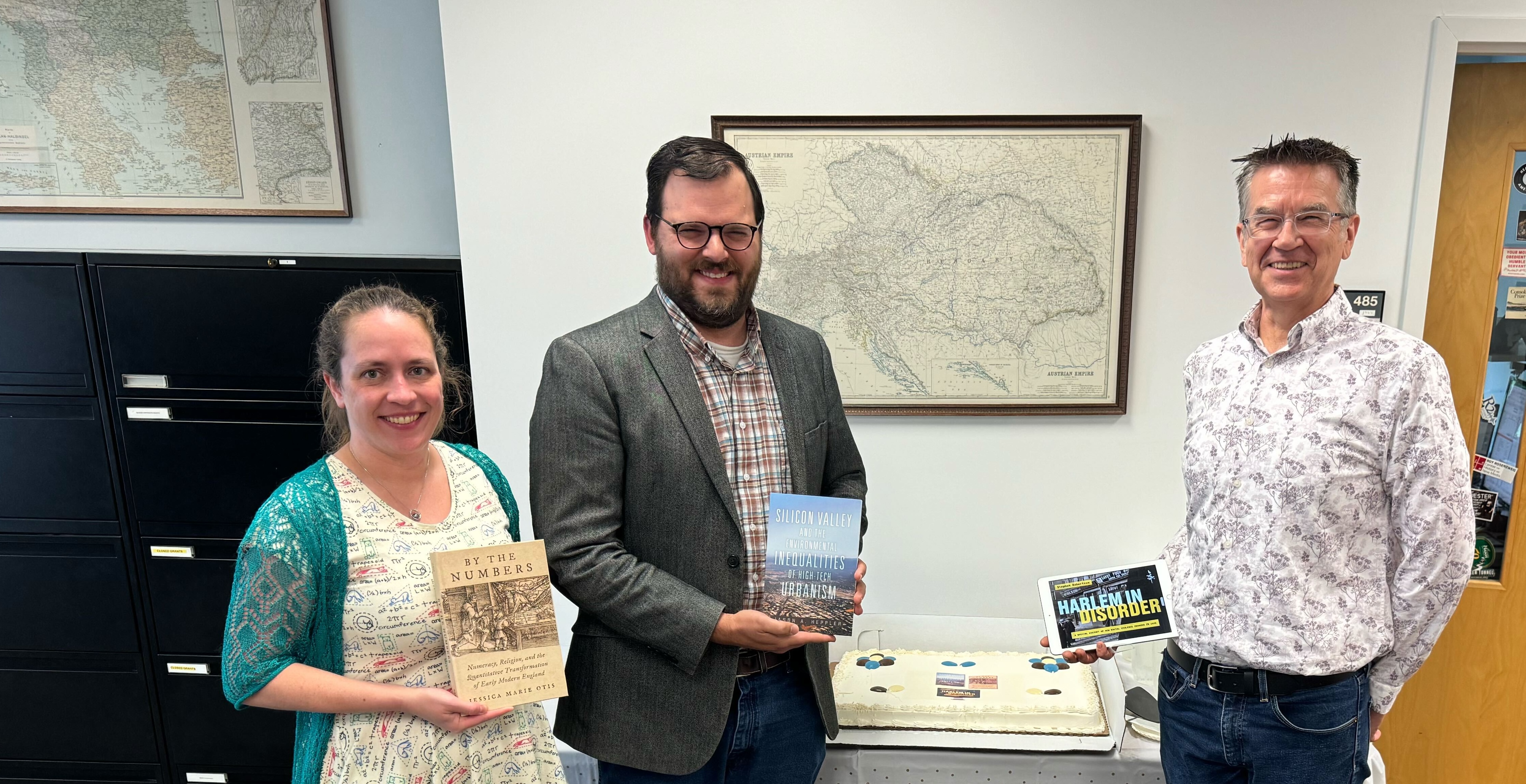
Silicon Valley and the Environmental Inequalities of High-Tech Urbanism 

Jason A. Heppler University of Oklahoma Press

In the half century after World War II, California's Santa Clara Valley transformed from a rolling landscape of fields and orchards into the nation's most consequential high-tech industrial corridor. How Santa Clara Valley became Silicon Valley and came to embody both the triumphs and the failures of a new vision of the American West is the question Jason A. Heppler explores in this book. A revealing look at the significance of nature in social, cultural, and economic conceptions of place, the book is also a case study on the origins of American environmentalism and debates about urban and suburban sustainability.

Publications

By the Numbers: Numeracy, Religion, and the Quantitative Transformation of Early Modern England 

Jessica Marie Otis Oxford University Press

By the Numbers explores the ways in which early modern English people interacted with and comprehended numbers in their daily lives, from basic counting and arithmetic to more complex mathematical operations. Jessica Marie Otis examines how numeracy, religion, and the quantitative transformation of early modern England were deeply intertwined, showing how the spread of Hindu-Arabic numerals changed the way people understood both the natural and the divine world.
2020

2017

Digital History and Argument 

Arguing with Digital History working group Roy Rosenzweig Center for History and New Media

A white paper from the Arguing with Digital History working group examining how digital historians make, support, and contest arguments using digital tools and methods.

2015

2009

2008

2007

2006

Ways of Seeing: Evidence and Learning in the History Classroom

Michael Coventry, Peter Felten, David Jaffee, Cecilia O'Leary, and Tracey Weis, with Susannah McGowan This article originally appeared in the March 2006 issue of The Journal of American History Volume 92, Number 4(March, 2006):1371-1402 and is reprinted here with permission.

2005

The Future of Preserving the Past

Daniel J. Cohen This article was originally published in CRM: The Journal of Heritage Stewardship 2, 2 (Summer, 2005): 6–19 and is reprinted here with permission.

American Digital History

Orville Vernon Burton This article was originally published in Social Science Computer Review, Vol. 23 No. 2, Summer 2005 206-220, reprinted here with permission.

2004

History and the Second Decade of the Web

Daniel J. Cohen Originally published in Rethinking History Vol.8, No.2, June 2004, pp. 293-301

More than ten years of experience with the web has allowed us to understand what the medium does well and what it does poorly, and how we may improve online historical efforts so they capitalize on the web's strengths while avoiding its weaknesses. This essay explores three possible ways to advance digital history: interaction between historians and their subjects, interoperation of dispersed historical archives, and the analysis of online resources using computationalmethods. Thinking about such possibilities raises important, age-old questions about how we should preserve and chronicle the past.

2003

2002

2001

2000

1999

The Future of Labor's Past

John Summers This article was originally published in Labor History 40, 1 (February 1999): 69-79 and is reprinted here with permission.

'We Shall Be All': Designing History for the Web

Paula Petrik Note: This presentation is part of a longer, more developed essay that is still in progress. As such, it does not contain the usual full complement of scholarly apparatus or all the arguments and examples of the extended version. Although you may refer to the presentation in general, please do not quote from this iteration of the essay. You may also find the pieces at my web site (http://www.archiva.net) helpful for discussions of information, aesthetic, and technical design.

1998

1997

1995